

The Rich Variety of Coffee

A journey through coffee history
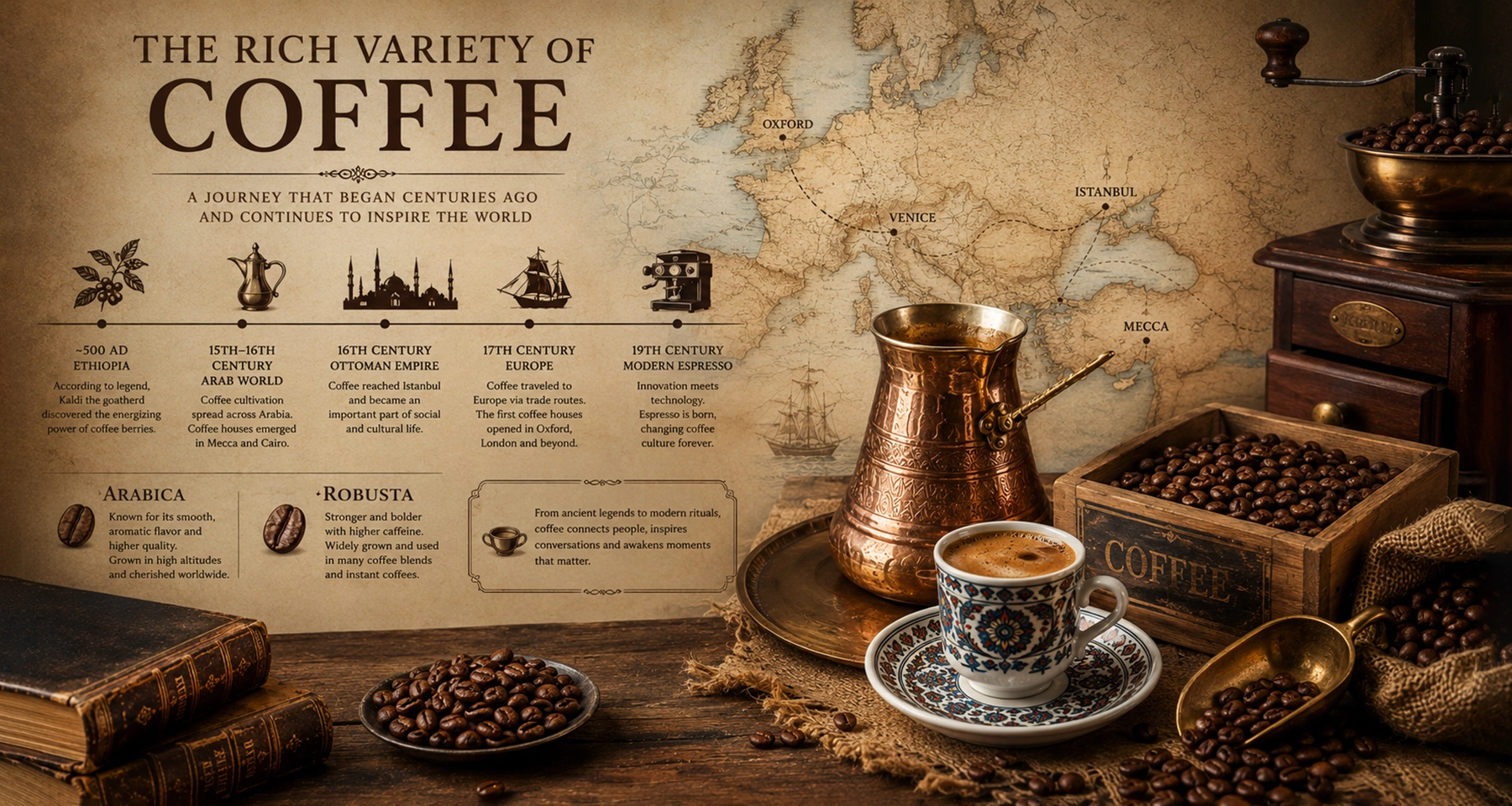
Coffee has traveled across continents and centuries, evolving from a mysterious berry discovered in the highlands of Ethiopia into one of the world’s most beloved beverages.
According to the famous legend, a goatherd named Kaldi noticed his goats becoming unusually energetic after eating the berries of a certain shrub. Curious, he tried the berries himself and shared his discovery with local monks. Although the story remains part legend and part folklore, it became one of the earliest tales associated with the discovery of coffee.
Over time, coffee spread throughout the Arabian Peninsula, where it became deeply connected to social, religious, and intellectual life.
The Rise of Coffeehouses
Some of the earliest coffeehouses appeared in cities such as Mecca, Cairo, and later Istanbul during the Ottoman era.
By the mid-16th century, Istanbul’s coffeehouses had become lively gathering places where people met to discuss literature, politics, music, philosophy, and daily life.
These coffeehouses later inspired similar café cultures throughout Europe.
Coffee Arrives In Europe
Coffee reached Europe through trade routes connecting the Ottoman world with cities such as Venice and Vienna.
In England, one of the earliest recorded coffeehouses opened in Oxford during the 17th century. Soon afterward, coffeehouses appeared in London, Paris, and across Europe.
Coffeehouses rapidly evolved into cultural centers frequented by merchants, artists, philosophers, writers, and political thinkers.
Arabica & Robusta
Today, most coffee consumed worldwide comes primarily from two species:
Arabica
Arabica coffee is known for its smoother, more aromatic flavor profile and is generally associated with higher-quality specialty coffee.
Its roots trace back to the Ethiopian highlands and the Arabian Peninsula.
Robusta
Robusta coffee contains more caffeine and typically produces a stronger, more bitter flavor. It is commonly used in instant coffee blends and some espresso blends.
Both varieties continue to shape global coffee culture today.
The Evolution of Espresso
The development of espresso transformed coffee culture once again.
During the 19th century, inventors in Europe experimented with machines capable of forcing hot water through tightly packed coffee grounds under pressure, eventually leading to the modern espresso machine.
Italy later became synonymous with espresso culture, influencing coffee traditions around the world.
Coffee Culture Today
From traditional Turkish coffee prepared in a cezve to modern espresso bars and specialty cafés, coffee continues to evolve while preserving centuries of ritual and craftsmanship.
For many people, coffee is far more than a beverage.
It is:
- conversation,
- hospitality,
- creativity,
- ritual,
- and shared human experience.
At Ottomans Coffee, we celebrate the remarkable journey of coffee — from its ancient origins to the rich and diverse coffee cultures enjoyed around the world today.