


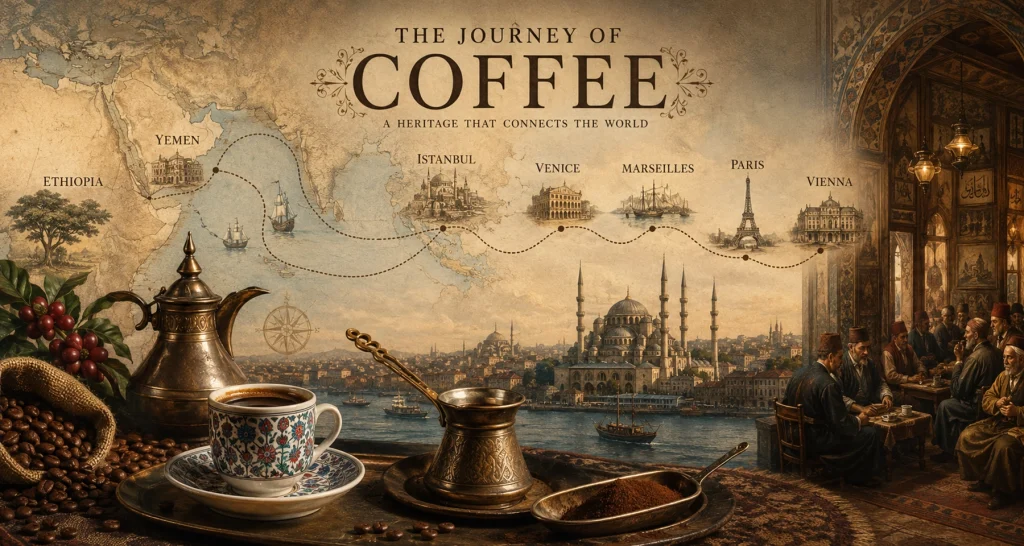
The history of coffee’s journey
From the ancient highlands of Ethiopia to the grand coffeehouses of Istanbul, coffee has traveled across continents for centuries, shaping cultures, conversations, and daily life along the way. At Ottomans Coffee, we celebrate not only coffee itself, but the timeless culture surrounding it — hospitality, storytelling, intellect, and human connection. The story of coffee is also the story of civilization, trade, art, and human gathering. Few beverages in history have influenced societies as deeply as coffee.
Ethiopia
The origins of coffee trace back to the ancient highlands of Ethiopia, where the coffee plant grew naturally in the wild. Early communities discovered the energizing qualities of its cherries and leaves long before coffee became the beverage we know today.
Over time, coffee’s reputation spread beyond East Africa, beginning a remarkable journey across the world.
Yemen & The Arabian Peninsula
Coffee spread throughout the Arabian Peninsula, particularly in Yemen, where cultivation and roasting methods evolved significantly.
By the 15th century, roasted coffee beans were being ground and brewed into a rich beverage remarkably similar to modern coffee. Yemen’s climate and trade routes helped transform coffee from a regional drink into an international commodity.
Ports across the Red Sea and the Eastern Mediterranean soon became part of coffee’s expanding world.
Istanbul & The Ottoman Coffeehouse Tradition
Coffee arrived in Istanbul during the reign of Suleiman the Magnificent and quickly became an essential part of Ottoman culture.
According to historical tradition, Özdemir Pasha, the Ottoman governor of Yemen, introduced coffee to the Ottoman court after developing a taste for the beverage during his service there.
Within a short time, coffee became deeply integrated into palace life. The role of kahvecibaşı — the Chief Coffee Maker — emerged as one of the trusted positions within the imperial court.
But coffee did not remain only within palace walls.
From royal kitchens, coffee spread into the homes, gardens, markets, and streets of Istanbul. The city soon became one of the world’s earliest and most influential coffee capitals.
In the mid-16th century, some of the earliest known coffeehouses opened in Istanbul, particularly in the Tahtakale district. These coffeehouses rapidly evolved into vibrant social and intellectual centers where people gathered to:
- discuss literature and poetry,
- play chess and backgammon,
- exchange news and ideas,
- listen to music and storytelling,
- and enjoy long conversations over freshly brewed coffee.
The Ottoman coffeehouse became far more than a place to drink coffee — it became a cultural institution.
This tradition would eventually inspire coffeehouse culture throughout Europe.
Venice
European merchants traveling between Venice and Istanbul helped introduce coffee to Italy in the early 17th century.
Venice soon embraced the beverage, and Italy’s first coffeehouses appeared shortly afterward. Coffee rapidly became associated with intellectual life, commerce, and artistic conversation.
Paris
Coffee reached Paris through diplomatic and cultural exchanges with the Ottoman Empire.
One of the most famous figures connected to coffee’s arrival in France was Ottoman ambassador Süleyman Ağa, whose elegant coffee gatherings fascinated Parisian society during the reign of Louis XIV.
By the late 17th century, Parisian coffeehouses had become gathering places for writers, philosophers, artists, and political thinkers.
Vienna
The story of coffee in Vienna is closely linked to the Ottoman–European encounters of the late 17th century.
Over time, Vienna developed one of the world’s most celebrated coffeehouse traditions, blending Ottoman influence with its own distinctive European café culture.
Viennese coffeehouses later became famous meeting places for intellectuals, musicians, and artists.
London
Coffee arrived in London during the 17th century and quickly became associated with scholars, merchants, and public debate.
London’s coffeehouses became known as “Penny Universities” because, for the price of a cup of coffee, visitors could participate in conversations about politics, science, philosophy, and business.
Coffee Across the World
From Europe, coffee cultivation and trade expanded across the Caribbean, Central America, and South America.
Over the centuries, coffee evolved into one of the world’s most important global commodities and one of humanity’s most beloved daily rituals.
Today, coffee continues to unite people across cultures and continents — just as it did centuries ago in the coffeehouses of Istanbul.
The Spirit of Coffee
At Ottomans Coffee, we honor this rich heritage and timeless tradition.
Coffee is more than a beverage.
It is conversation.
It is hospitality.
It is culture.
It is history shared one cup at a time.